Brands make big plans in the office: new listings, planograms, promotions and displays. Retail execution is what happens to those plans in the store. Retail execution KPIs show whether the plans actually reached the shelf.
Without these KPIs, you only see sales. Sales tell you something went well or badly, but not why. Execution KPIs fill that gap. They show what shoppers really saw, store by store.
This guide explains the most important retail execution KPIs, how to calculate them and how to use them together.
Sales data is late and mixed. It includes the effect of price, competition, season and execution all at once. Execution KPIs are closer to the cause. They help you:
The best KPI set is small. A few clear measures that everyone understands are better than a long dashboard nobody reads.
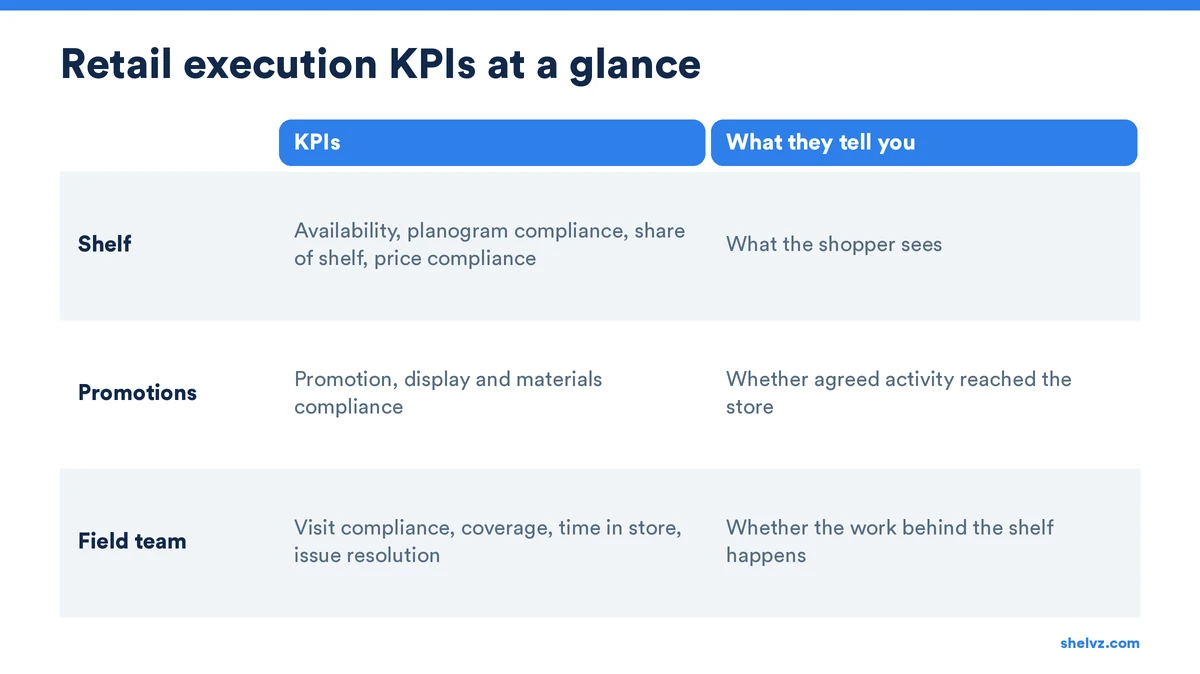
These KPIs describe what the shopper sees.
The share of listed products that are on the shelf when checked.
On-shelf availability = products found on shelf ÷ products that should be there × 100
It is usually the most important execution KPI, because a missing product cannot sell. Read our guide to on-shelf availability in Saudi retail for more detail.
How closely the shelf matches the agreed planogram: right products, right place, right number of facings. Our planogram compliance guide explains how to measure it.
Your facings as a share of all facings in the category. See our guide on share of shelf for the formula and examples.
The share of checked products where the shelf price matches the agreed or recommended price, and a price tag is present.
These KPIs show whether promotions run as planned.
The share of agreed promotion elements, such as price, display, materials and stock, that are in place in each store. Our article on promotion compliance audits explains the scoring.
The share of paid or agreed secondary displays that are built, in the right place and full.
The share of point-of-sale materials that are in place and visible.
Like what you’re reading?
Take a moment to subscribe before continuing and never miss out on exclusive insights, news, and case studies.
These KPIs show whether the work behind the shelf is happening.
| KPI | What it measures |
|---|---|
| Visit compliance | Planned visits completed |
| Time in store | Average minutes per visit, by store type |
| Coverage | Share of the store universe visited in the period |
| Task completion | Share of assigned tasks completed |
| Issue resolution time | Time from a problem being reported to it being fixed |
Field team KPIs explain shelf KPIs. If availability is low in a region, check visit compliance there first. For more on field measures, see field sales KPIs that drive real performance gains.
One KPI alone can mislead. Read them as a set.
This is why execution data matters so much in reviews. It separates execution problems from commercial problems.
Every KPI on this list depends on field data. If the data is weak, the KPIs are weak too. Three checks keep data trustworthy:
It also helps to watch for data that looks too good. A rep who always reports full availability in stores that others find empty may need coaching. Our article on AI image recognition and retail execution bias explains how photos and automation make data more objective.
Shelvz brings availability, planogram, promotion and visit data together in live dashboards, built from the work your field team already does. Explore Shelvz merchandising or book a demo.
Targets should be realistic and fair.
A useful dashboard answers three questions quickly:
Keep the dashboard close to the data source. When KPIs update after each visit, managers can act within days instead of weeks. Our article on real-time insights for portfolio visibility explains why speed matters.
For most FMCG brands, on-shelf availability comes first, because a missing product cannot sell. Planogram compliance and share of shelf come next.
Review urgent issues daily, store patterns weekly and overall trends monthly.
Field operations usually own the data, but sales, trade marketing and key account teams all use it. Agree who owns each KPI and its follow-up.
To see how Shelvz tracks retail execution KPIs from field data, book a demo.