Every brand wants more space on the shelf. But few brands can say exactly how much space they have today, in which stores, and whether it is going up or down.
That number is called share of shelf. It is one of the simplest measures in retail execution, and one of the most useful. It shows how visible your products are compared with everything else in the category.
This guide explains what share of shelf means, how to calculate it, how to track it across many stores, and what you can do to grow it.
Share of shelf is the part of a category’s shelf space that your brand holds. If a shopper looks at the juice shelf, share of shelf answers one question: how much of what they see is yours?
Most brands measure it in one of three ways:
Pick one method and keep it. Mixing methods between stores or between months makes the numbers impossible to compare.
Share of shelf is often compared with share of market, which is your part of category sales. The two numbers should be close. If your share of shelf is much lower than your share of market, shoppers may not find you, and you are probably losing sales. If it is much higher, the retailer may soon ask why you hold space your sales do not support.
The formula is simple:
Share of shelf = your brand’s facings ÷ total facings in the category × 100
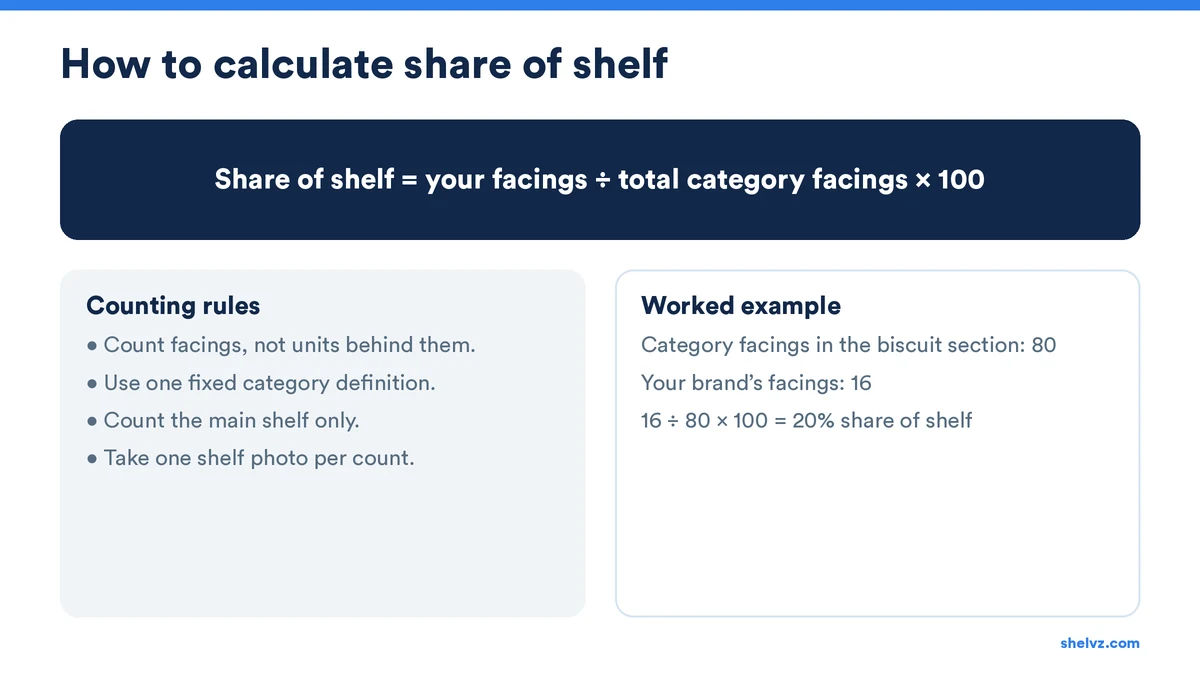
Here is a short example. A store’s biscuit section has 80 facings in total. Your brand has 16 of them. Your share of shelf in that store is 16 ÷ 80 × 100 = 20%.
A few rules keep the number honest:
For more on what to check during a visit, see our guide to retail execution audits.
Like what you’re reading?
Take a moment to subscribe before continuing and never miss out on exclusive insights, news, and case studies.
Shoppers buy what they see. When a product is hard to find, many shoppers choose another brand rather than search. Share of shelf is a direct view of how easy you are to find.
It also helps in three practical ways:
Share of shelf works best next to other shelf measures, such as planogram compliance and on-shelf availability. Together they show whether your products are there, in the right place, and in the right amount.
Counting one shelf is easy. Counting hundreds of shelves every week, and comparing the results, is where most brands struggle. Paper forms and spreadsheets arrive late, use different methods, and are hard to check.
A good tracking routine has four parts.
Decide which stores matter most. Key accounts may need a count on every visit. Smaller stores may need a count once a month.
A short, fixed form in a mobile app keeps every rep counting the same way. Ask for total category facings, your facings and your main competitors’ facings, plus one shelf photo.
The value is in the patterns. A drop in one chain or one city tells you where to act first. Dashboards that update after each visit save managers from building reports by hand.
Data that is not used is wasted effort. Set a simple rule, for example: any store where share of shelf drops below target for two visits in a row gets a follow-up from the area manager.
Shelvz lets field teams count facings and take shelf photos on every visit, so share of shelf updates as the work happens. Explore the Shelvz merchandising solution or book a demo to see it with your own stores.
Growing share of shelf takes work in the store and in the office. These levers make the biggest difference.
The planogram is where shelf space is decided. Bring data to range reviews: your sales per facing, your availability record and your promotion plans. Our article on planogram and product assortment best practices covers this in more detail.
Many brands lose space they already agreed. Products get moved, competitors spread into your space, or empty shelf gets filled with something else. Regular visits and photo checks protect what you won.
An empty facing often gets filled by another product, and it may not come back. Strong availability protects your space. Fast restocking and good stock rotation are part of share-of-shelf strategy, not separate from it.
Gondola ends, floor stands and chiller units add visibility beyond the main shelf. Track them separately, and check that they are in place for as long as you are paying for them.
Not every store deserves the same effort. Put your merchandising time where the category is large and the gap between your share of shelf and your share of market is widest.
There is no single good number. A useful target is a share of shelf close to your share of market in that category and channel. Brands that are growing or launching products often aim slightly higher.
Measure key stores on every visit and smaller stores at least once a month. The right rhythm depends on how fast your category changes and how often competitors run promotions.
Not quite. Share of shelf usually covers the main shelf only. Share of visibility also includes secondary displays, branded fridges and point-of-sale materials.
If you want to see how your field team can capture share of shelf on every visit, book a demo with Shelvz.
