Brands spend a lot of money on promotions. They agree prices, displays and materials with retailers and distributors. Then the promotion starts, and most brands hope it is running as planned.
Hope is not a plan. In many stores, at least one part of the promotion is missing: the price is wrong, the display is not built, or the materials are still in the back room.
A promotion compliance audit checks that each store is running the promotion as agreed. This guide explains what to check, when to check it and how to fix problems while the promotion is still live.
Promotion compliance means the promotion in the store matches the promotion you agreed. It usually covers four things:
If any one of these is missing, the promotion loses part of its value. A great price that shoppers cannot see does little. A great display with an empty shelf does even less.
Most promotion failures are not bad decisions. They are execution gaps. Common causes include:
Many of these are covered in our article on the missing link in your trade promotion strategy. The key point is simple: you cannot fix what you do not see.
Keep the audit short. A long form slows visits and leads to rushed answers. Focus on the items that affect sales.
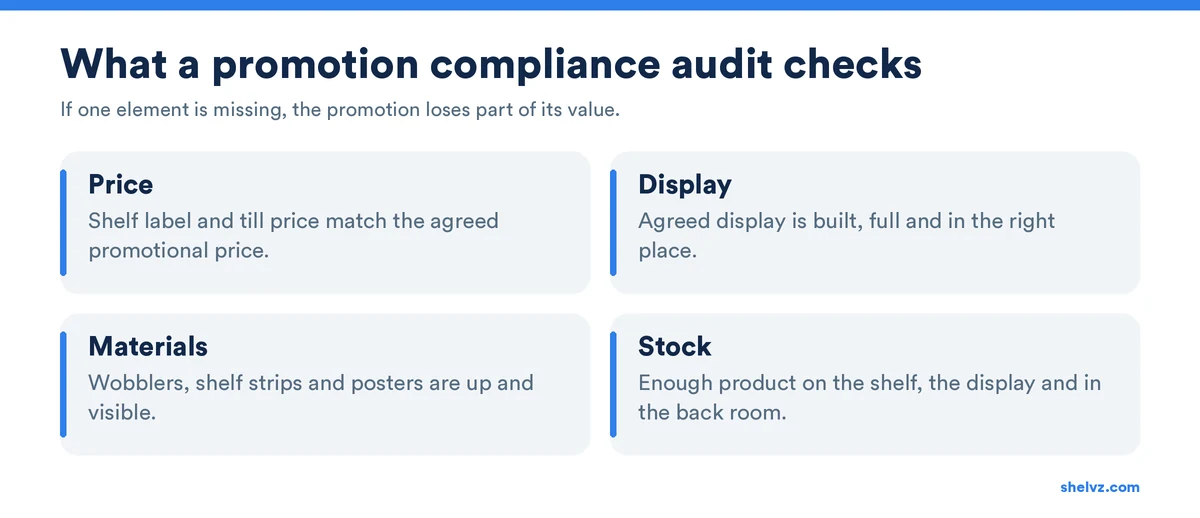
Check the shelf label and, where possible, the price charged at the till. Record both. Photograph the shelf label.
Is the display built? Is it in the agreed location? Is it full? Take one photo that shows the display and its position in the store.
List the materials that should be in place. Ask the rep to confirm each one and take a photo. Note anything damaged or missing.
Check stock on the shelf, on the display and in the back room. Low stock early in a promotion is a warning sign for the rest of the period.
Note any competitor promotion in the same category. It helps explain results later. Our guide on monitoring competitor activities and promotions covers this in detail.
Like what you’re reading?
Take a moment to subscribe before continuing and never miss out on exclusive insights, news, and case studies.
Timing matters more than most teams think.
An audit done only at the end tells you what went wrong. An audit done in the first days lets you fix it.
A simple score makes results easy to compare across stores, chains and regions. One common approach is a checklist score:
Promotion compliance score = items in place ÷ items checked × 100
For example, if a store should have a correct price, a display, two materials and enough stock, that is five items. If four are in place, the store scores 80%.
You can also weight the items. Price and stock often matter more than a single poster. Keep the scoring rules the same for the whole promotion so results stay comparable.
Shelvz attaches a short promotion checklist to every store visit, with photos and price checks, so you see compliance while there is still time to act. Explore Shelvz trade promotion or book a demo.
The value of an audit is in the follow-up. Set clear rules for what happens next.
Alerts help here. When a rep reports a missing display, the right manager should know the same day, not at the end of the month.
Compliance data makes promotion analysis more honest. If a promotion performed badly, was it the offer or the execution? Without compliance data, you cannot tell.
Compare results in compliant stores against non-compliant stores. This helps you understand the real effect of the promotion and improves the next plan. For the measurement side, see our guide on how to measure trade promotion ROI.
Compliance data also helps with distributor claims. If you pay for displays, you can check that the displays were built before you pay.
Aim for full compliance in your most important stores. Use the score to rank stores and focus effort where the gaps are largest, rather than as a pass or fail number.
Your own field team, a merchandising agency or the distributor’s team can run them. What matters most is one standard checklist and photo proof, whoever does the visit.
A focused check should take only a few minutes per promotion. Keep the form short so reps have time to fix problems, not just record them.
To see how Shelvz helps teams check promotions in every store, book a demo.
