Mystery shopping shows you what customers really experience in your stores or branches. But the results are only as good as the questions you ask.
A poor questionnaire gives vague, unfair or unusable answers. Staff lose trust in the programme, and managers stop acting on the reports. A good questionnaire gives clear facts that point to specific actions.
This guide explains how to design a mystery shopping questionnaire that works: what to ask, how to word it, how to score it and how long it should be.
Before writing a single question, decide what the programme is for. Common goals include:
Each goal leads to different questions. A questionnaire that tries to cover everything becomes long and tiring, and the quality of answers drops. Our article on mystery shopping for retail compliance shows how a clear goal shapes the whole programme.
Write questions in the order the shopper experiences the visit. This makes the questionnaire easier to complete from memory and keeps it logical.
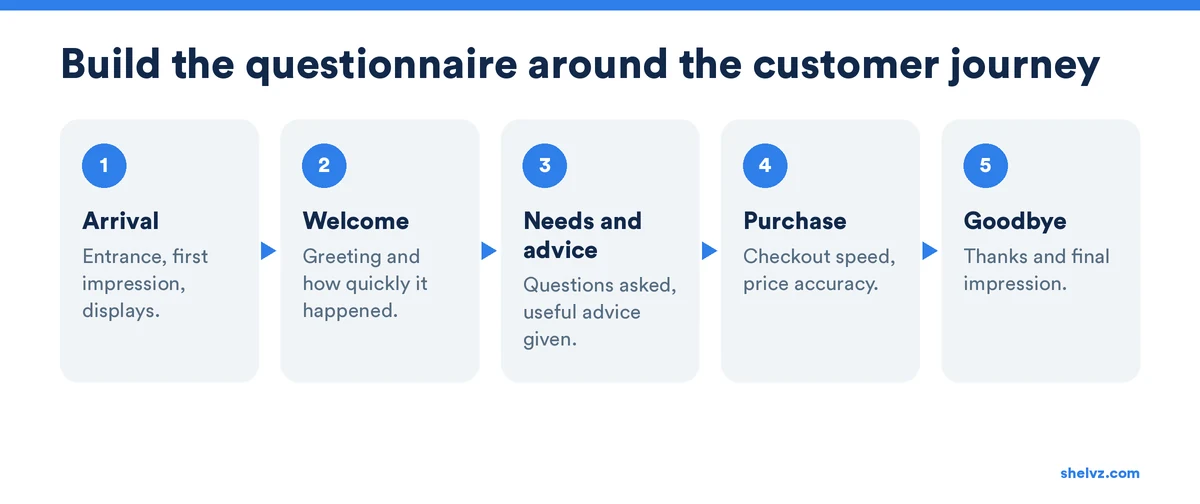
A typical journey has five stages:
For each stage, list only the behaviours that matter most to your customers and your brand.
The wording of each question decides how reliable the answer is.
“Was the shopper greeted within the first minute?” is a fact. “Was the welcome warm?” is a feeling. Use facts for scored questions. Keep feelings for a few comment questions.
“Was the staff member friendly and knowledgeable?” mixes two things. If the answer is no, you do not know which part failed. Split it into two questions.
“Did the staff member fail to offer help?” pushes the shopper towards an answer. “Did a staff member offer help?” is neutral.
If you ask “Was the store clean?”, shoppers will judge differently. Add a short guide, for example: “Floor free of litter, shelves free of dust, no boxes in the aisle.”
Like what you’re reading?
Take a moment to subscribe before continuing and never miss out on exclusive insights, news, and case studies.
Shorter is usually better. Shoppers must remember everything after the visit, and long forms lead to guessing.
A good rule is to include only questions that lead to action. For each question, ask: “If the answer is bad, what will we change?” If there is no clear answer, remove the question.
Skip logic helps keep forms short. If the shopper did not use the fitting room, the fitting-room questions should not appear.
Scores make results easy to compare across branches and over time.
| Scoring choice | How it works | When to use it |
|---|---|---|
| Equal weights | Every question counts the same | Simple programmes, early stages |
| Weighted questions | Key behaviours count more | When some standards matter much more |
| Section scores | Score each journey stage separately | To show where in the journey things fail |
| Critical questions | A “No” caps or fails the visit | Legal, safety or brand-critical rules |
Keep scoring rules fixed for at least a full cycle. Changing them in the middle makes trends meaningless.
Shelvz mystery shopping lets you build questionnaires with photo questions, skip logic and automatic scoring, and see results by branch as visits are submitted. Explore Shelvz mystery shopping or book a demo.
Staff will accept mystery shopping when they see it as fair. A few rules help:
Our guide on leveraging mystery shopping data for continuous improvement explains how to turn reports into coaching.
Run a small pilot in a few branches. Then check:
Adjust the questionnaire, then launch it across all branches.
You can find more ideas in our mystery shopping checklist.
There is no fixed number. Keep only questions that lead to action, and use skip logic to hide questions that do not apply to the visit.
Yes, where it is allowed and safe. Photos of displays, prices and cleanliness make results more accurate and easier to accept.
Review it once or twice a year, or when your service standards change. Avoid changing scoring rules in the middle of a reporting cycle.
To see how Shelvz helps you build and run mystery shopping questionnaires, book a demo.
